


The Real Issue with This Lorry Park Proposal and Operation Brock and Operation Tap
Updated: Jan 25

Current statistics reveal that up to 10,000 lorries use Dover Port everyday. The Port of Dover have not got the capacity to hold the freight for significant periods of time before departure
This has led to the establishment of various schemes over the years, both Operation Brock on the M20 and Operation Tap on the A20 - see differences below
Common Confusion: TAP vs. Stack and Brock
While "Operation Tap" is frequently used by locals, it is part of a broader set of measures:
Dover TAP: Small-scale, daily management on the A20.
Operation Brock: Larger-scale management on the M20 motorway using a contraflow system to "stack" lorries during major disruptions.
Operation Stack: The predecessor to Operation Brock, which involved closing sections of the M20 entirely to park lorries.
Problems with Operation Dover Tap
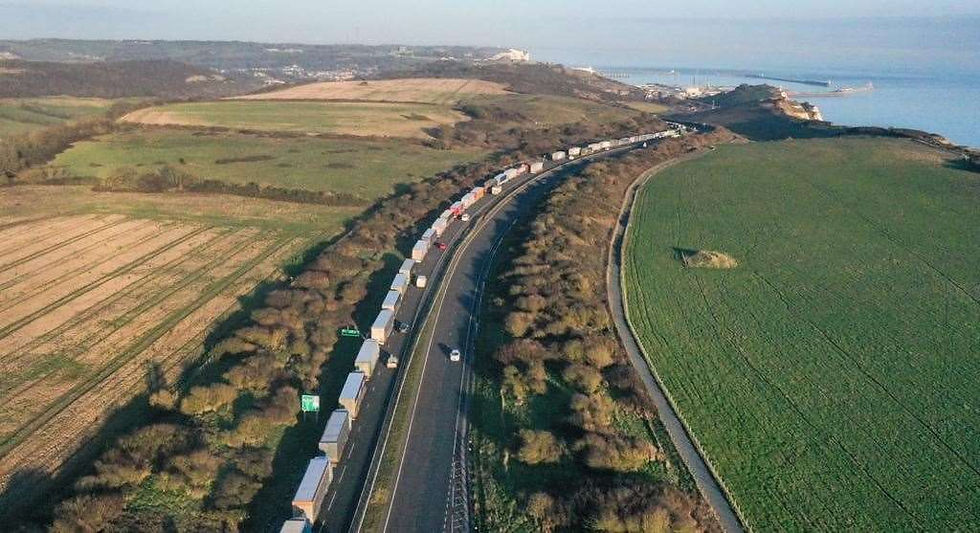
Operation Dover TAP (Traffic Assessment Project) is a permanent traffic management system on the A20 designed to prevent port-bound freight from gridlocking Dover town. While effective at protecting the town center, it creates several persistent issues for residents, businesses, and drivers.
1. Significant Disruption for Local Residents
Aycliffe Neighbourhood Isolation: Residents in Aycliffe, located directly along the A20, are most impacted by idling lorries. Common complaints include sleep disturbance from engine noise (often starting as early as 4 a.m.) and increased air pollution from stationary HGVs.
Access Delays: When TAP is active, local traffic must use a single lane alongside miles of queued lorries. Residents often face delays of over an hour for short local trips, such as traveling from Whitfield into Dover for shopping.
Tunnel Closures: To prevent dangerous fume build-up, the Roundhill Tunnel is often closed coastbound if the TAP queue stretches too far back. This forces all non-port traffic onto long diversions through Folkestone and Capel Le Ferne.
2. Economic Impact on Dover Businesses
Deterring Shoppers: Local council members have noted that frequent TAP activation deters visitors from neighbouring towns (like Deal and Capel) from visiting Dover’s retail centres, such as St James’, harming local trade.
"Sacrificial Lamb" Sentiment: There is a recurring local perception that Dover is "sacrificed" to keep the rest of the UK's freight moving, with inadequate compensation for the town's lost productivity.
3. Welfare and Safety Concerns
"Queue Jumping" Dangers: Passenger vehicles and lorries attempting to bypass the queue in the right-hand lane create safety risks. HGVs caught trying to bypass TAP are turned around by police, which can further compound local congestion.
Confusion and Poor Signage: Drivers frequently report that electronic signs are poorly positioned or partially obscured by trees, leading to "clumping" and sudden braking.
4. Systemic Overuse
"Habitual" Activation: Originally intended for major disruptions, TAP is now used almost daily due to increased border check times (the EU Entry/Exit System and post-Brexit customs) and ferry maintenance cycles.
Mandatory Speed Limits: The mandatory 40mph limit applies to all vehicles on the A20 coastbound whenever TAP is active, which many motorists find frustrating during periods where the road ahead is actually clear.
Economic & Social Impact
Loss of Revenue: A 2022 survey found that 76% of Kent firms reported a negative effect on their business, with some planning to relocate away from the area.
Reduced Tourism: Potential visitors often avoid Kent during "active" periods, resulting in lost revenue for local attractions and coastal towns.
Commuter Delays: Journeys that normally take 20–30 minutes can extend to over 90 minutes or even several hours, impacting work-life balance and health
False Assumptions
A new lorry HGV lorry park at the Court Wood Jnc on the A20 will solve Operation Tap.
INCORRECT- The lorry park will have a capacity for 600 lorries , Dover Tap itself is 500 lorries long in full operation, and there will also potentially be another 3000-4000 lorries waiting in Operation Brock .This proposal wouldn't even touch the sides to solve Operation Tap or Brock
Furthermore it will create traffic management problems siting the HGV lorry park too close to Dover, right in the middle of Dover Tap on the A20 with no effective traffic management scheme or model to deal with entry and exit whilst Dover Tap is in existence
RESULT- Local residents living in and around Dover Town Centre and Aycliffe will still experience long queues of lorries via Dover Tap and all of the associated problems listed above with this. This will also create major traffic congestion at the A20 Court Wood Jnc making it gridlocked with lorries trying to both enter and exit from Dover Tap
Outcomes
A lorry park at the Court wood Jnc on the A20 would be too close to existing traffic management problems that already exist in Dover (Dover Tap), and far from alleviating these problems it would actually exacerbate existing traffic congestion problems in the Dover District and decrease the Port of Dover's resilience and management of freight
The number of lorry parking places offered by this proposal would not stop either Operation Brock or Dover Tap from happening.
The lorry park would be built in one of the most highly protected National Landscapes in the UK , i.e. The Kent Downs National Landscape- 450 meters from the iconic white cliffs of Dover
The lorry park would propose a two way directional traffic road layout on the same off ramp from the A20 . Something fraught with dangers with foreign lorry driver use and confusion over which side of the road to drive upon
The location instead of alleviating "rat running" by lorry drivers would actually exacerbate this around the Court Wood Jnc on the A20 , with drivers using the B2011 into Dover to avoid re-joining the existing Dover Tap queue on the A20
This proposed lorry park would be 8 miles after the entrance to the Channel Tunnel at Jnc 11 a . Potentially causing freight to have to turn around and back track to the Channel Tunnel for departure. This causing further journeys and freight on the A20 /M20
The building of the lower Thames Crossing by 2035 will mean a significant number of lorries will not use the A20 into Dover , but the M2 / A2 . This proposal doesn't do anything to alleviate these future problems
The amount of freight travelling through Dover port has reached capacity and there should be more strategic thinking about using alternative ports like Ramsgate/Sheerness to spread freight traffic away from existing bottle necks such as Operation Dover Tap/Operation Brock
The emergency plans for extra lorry parking already exist at Manston airport (4000 lorry spaces) and have been used frequently when Operation Brock/Operation Tap are in force
Sevington Inland Border Facility is built, has permission to operate and regularly has spare capacity for lorries. It is also sited beside the M20, before the Channel Tunnel and Dover Port, with good existing three lane motorway connections
This HGV Lorry Park Proposal is in the wrong place and will not solve either Operation Brock or Operation Dover Tap


Until capacity is increased at the Port of Dover, these issues will only continue and grow. Even an increase in capacity will not stop 'Tap' altogether due to the bottle neck past Dover town (and the recently allowed McDonalds drive-thru on this route will only add to the congestion, well done DDC). Reclaiming land at the port to allow lorries to park at their UK destination whilst waiting for their ferry, and ensuring efficient systems are in place for security checks etc, and dare I suggest increased sailings at those known 'peak' times, are surely the only longer term solutions.
These proposed lorry parks are merely sticking plasters trying to mend bullet holes.
Destroying pockets of countryside that is already…